
The Balanced Plate
No calorie counting, no complicated rules, just one straightforward framework that changes how your body responds to every meal.
Let me share something I say to clients all the time. No naked carbs.
It always raises an eyebrow, but once I explain it, it sticks and it changes how people eat more than almost anything else I teach.
A naked carb is a carbohydrate eaten alone. Toast on its own, a banana on the go, rice cakes as a snack or a bowl of cereal with nothing else. These foods are not inherently bad, but eaten without protein, fat or fibre alongside them, they send blood sugar rising quickly and dropping just as fast.
And that drop is where the trouble starts. The tiredness. The craving for something sweet an hour later. The mid-morning slump that you have quietly started to accept as just how you are.
It is not just how you are. It is what happens when carbohydrates go in without anything to slow them down.
So my rule: No naked carbs. Always dress them with protein, fat or fibre — ideally all three.
Why combination is everything
When you eat carbohydrates alongside protein, fat and fibre, the whole picture changes. Protein and fat slow gastric emptying - the rate at which food leaves your stomach. Fibre buffers how quickly glucose enters the bloodstream. The result is a gentler, steadier rise in blood sugar, more consistent energy, and a body that stays fuelled for two to three hours without the crash.
This is the principle behind the balanced plate. Not a diet. Not a plan. Not a list of foods you can and cannot eat. Just a way of thinking about every meal that becomes instinctive over time, and genuinely changes how your body responds.

I use it with everyone - from women navigating perimenopause to athletes fuelling for performance to busy professionals who just want to stop hitting a wall at 3pm. The framework is the same. The portions and priorities shift depending on the person.
There are changes to this plate - high volume exercise, where the plate needs to increase in carbohydrates
The four things on every plate
Your hand is your guide. No scales, no apps, no counting.

Protein — palm size
Protein is the anchor. It slows digestion, supports satiety, blunts the glucose response to everything else on the plate, and provides the building blocks your body needs to repair, rebuild and recover. Most people eat nowhere near enough of it — especially at breakfast.
Think: eggs, chicken, fish, Greek yoghurt, cottage cheese, legumes, tofu, quality red meat. A portion roughly the size and thickness of your palm at every meal is the target.
Carbohydrates — fist size
Carbohydrates are not the enemy. Naked carbohydrates are the problem. Dressed well — alongside protein, fat and fibre — they are an important source of energy, particularly for an active body or a busy brain.
Three things matter when it comes to carbohydrates on your plate:
Quality — whole, minimally processed carbohydrates are higher in fibre and harder to break down quickly, which means a steadier blood sugar response. Think oats, sweet potato, brown rice, quinoa, sourdough or rye bread, lentils and legumes. These are very different in their effect on your body to white bread, white pasta or most breakfast cereals.
Quantity — even good carbohydrates create a larger blood sugar response in larger amounts. A closed fist is your guide. Sometimes a few tablespoons is enough, sometimes you need a little more — this varies with how active you are and what your body is asking for.
What you eat with it — this is the most powerful lever of all. The same carbohydrate eaten alone versus eaten alongside protein, fat and fibre will have a completely different effect on your blood sugar. Never send them out naked.
Simple swaps worth knowing:

These are not sacrifices — they are upgrades that keep energy far more stable.
A note on the glycaemic index
You may have heard of the glycaemic index — a scale that ranks carbohydrates by how quickly they raise blood sugar. It runs from 0 to 100. Low GI foods (under 55) raise blood sugar gently and slowly. High GI foods (over 70) raise it quickly.
It is a useful guide, but not a rigid rulebook. Here is the most important thing to understand: the glycaemic index of a food changes depending on what you eat it with. A high GI food eaten alongside protein, fat and fibre behaves very differently in your body than the same food eaten alone. This is exactly why the balanced plate works — the combination changes everything.
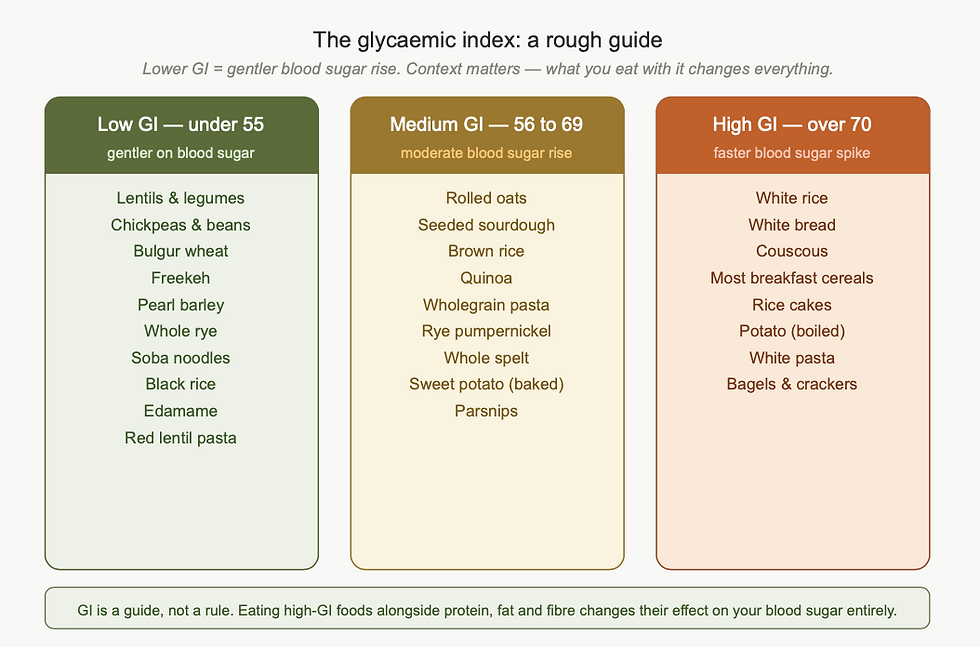
Use the guide above as a starting point. Over time you will build an intuitive sense of which carbohydrates serve you best — and the swaps start to feel effortless rather than restrictive.
Vegetables — two to three cupped hands
This is the component most people underestimate and underfill. Vegetables provide the fibre, micronutrients, polyphenols and water content that support gut health, liver function, hormonal balance and immunity. They also slow glucose absorption and add bulk to a meal without significantly adding to the blood sugar load.
Variety matters more than perfection. Leafy greens, broccoli, courgette, peppers, cucumber, tomatoes, carrots - the broader the range across the week, the better the support for your gut microbiome. Aim to eat the rainbow, not the same two veg every day.
Healthy fat — thumb size
Fat was unfairly demonised for decades and we are still recovering from that messaging. Healthy fats slow glucose absorption, support brain function, aid hormone production and help your body absorb fat-soluble vitamins. They are also genuinely satiating, meals with fat in them keep you fuller for longer.
Think: avocado, olive oil, nuts, seeds, oily fish, full-fat natural yoghurt, eggs. A thumb-sized amount is enough to shift how your body responds to the entire meal.
Dress every carbohydrate. Protein, fat and fibre are the outfit. Never send them out naked.
The athlete exception
Before anyone messages me — yes, there are exceptions. And the main one is this.
If you are an athlete heading into a long endurance session — a two-hour run, a long bike ride, an extended swim — a fast-acting carbohydrate on its own before or during that session can be exactly what you need. Easily absorbed glucose that is available quickly for working muscles. A banana mid-run, a gel at mile eight, a rice cake before a long ride. In this context, the naked carb is doing its job.
The same applies to the window immediately after intense training, when replenishing glycogen quickly is the priority. Context matters. If your body is about to use that glucose immediately and completely, it does not need slowing down.
But — and this is important — this is the exception, not the rule. For most people, most of the time, in everyday meals and snacks, no naked carbs holds. Even for athletes, the principle applies at every meal that is not directly fuelling or recovering from training.
One more thing: the order matters too
There is increasingly strong evidence, explored brilliantly by Jessie Inchaupé in The Glucose Revolution - that the order in which you eat the components of a meal affects blood sugar response. Eating vegetables first, then protein and fat, then carbohydrates last, appears to meaningfully reduce the glucose spike from that meal.
If you tend to reach for the bread first, it is worth experimenting. Eat the salad. Then the protein. Then the carbs. Notice whether your energy after the meal feels different.
Small shift. Meaningful result.
Your 1% this month
You do not need to overhaul everything at once. Just start here.
Pick one meal today — breakfast is a great place to start — and ask yourself: are the carbohydrates dressed? Is there protein? Is there fat? Is there fibre?
If not, add one thing. A boiled egg alongside the toast. A spoonful of nut butter in the smoothie. A handful of nuts with the fruit.
Notice how you feel two hours later. Whether the slump arrives or whether it quietly stays away. Whether the cravings come or whether you reach the next meal without desperation.
Your body gives very clear feedback when you feed it well. You just need to start listening.
This blog is part of the May 1% Gains newsletter. Not yet subscribed? Sign up at kateslatter.com to receive practical, no-pressure health support every month.
Want support building meals that work for your body?
Whether you want to understand blood sugar, improve your energy, or simply feel more in control of how you eat — a free 30-minute Health & Energy Review is a good place to start.

Comments